
Cost per kilometre: will your next car pay off on Uber and Bolt?
Cost per kilometre = all of a month's costs ÷ all kilometres driven. For a Mietwagen (a private hire car licensed under Germany's passenger transport act) that means lease or loan, insurance, vehicle tax, maintenance, fuel or charging, and driver wages. Another car only pays off when its revenue after the Uber or Bolt commission covers all of it. We work through it step by step below.
- You see what each of your cars costs per kilometre and what is left after commission.
- You spot a loss-making car before it drains your account – one operator found a van that was losing a few hundred euros every month.
- You decide on car number 3, 4 or 5 with your real numbers, not gut feeling.
Last updated: 25 November 2026 · sources linked in the text · not legal or tax advice
See which of your cars really earns money
A personal demo built around your cars. Set up in about 48 hours, then 2 days free – no credit card.
Good weekly payouts, empty account?
The weekly statements from Uber and Bolt look fine. Yet at the end of the month there is little left. Rarely is it one big cost. It is many small ones that never end up on the same page.
- Receipts everywhereThe lease is a direct debit, the workshop invoice comes by post, the fuel receipt arrives on WhatsApp. You only roughly know what a single car costs per month.
- Revenue without profitA car is out every day and brings in good revenue – and still earns nothing after commission, wages and repairs. Without costs per car, you never notice.
- The offer for car no. 4The dealer has a tempting lease offer. Whether the car carries itself with a driver, insurance and empty trips, you have to guess.
A real case: one operator put all costs per car side by side for the first time and found a van that was losing a few hundred euros every month. A few hundred a month adds up to several thousand a year – money your other cars have to earn back first.
How do you calculate cost per kilometre for a Mietwagen?
Divide all of a month's costs by all the kilometres the car drove that month. The key word is all: including the empty kilometres back to your base and the months the car sat in the workshop.
Cost per km = (fixed + variable + driver costs) ÷ km driven
- Fixed costs for the month
Lease or loan payment, insurance, vehicle tax, a share of the annual inspection, cleaning, phone and admin. - Variable costs
Fuel or charging, maintenance, tyres and wear. These rise with every kilometre. - Driver costs
Wages and employer costs for the hours the car was on the road. If you drive yourself, at least count your own time. - Divide by all kilometres
Use the odometer at the start and end of the month, not just the paid kilometres in the app. - Compare with revenue per kilometre
After platform commission. If net revenue is below cost, the car is losing money.
In short
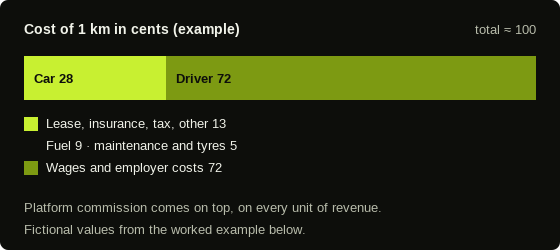
In a Mietwagen business, the car itself is often the smaller part of the cost. The biggest block is usually the driver – so what counts is how many hours a car is out with a driver and how much it earns in that time.
Why empty kilometres count
German law has a Rückkehrpflicht (return-to-base rule): after each job, a Mietwagen must return to its base without delay unless it received a new booking before or during the trip (§ 49(4) PBefG). These return trips cost fuel, wear and driver time but earn nothing. So divide costs by all kilometres and revenue only by the paid ones.
What does a Mietwagen cost per month? A worked example
One car, two drivers on part shifts, 7,000 km a month, 4,600 km of them with a passenger. All numbers are fictional, shown without currency and before VAT. Replace each line with your own figures – the method is next to it.
Redo it with your own numbers
- Fuel: km × consumption per 100 km ÷ 100 × price per litre.
7,000 × 5.5 ÷ 100 × 1.70 = 654.50 - Maintenance and tyres: km × rate per km.
7,000 × 0.05 = 350.00 - Driver wages: hours × hourly wage. The example uses 13.90 per hour, the German statutory minimum wage of €13.90 gross since 1 January 2026 (§ 1 MiLoV5).
300 h × 13.90 = 4,170.00 - Cost per km: total ÷ all km.
6,974.50 ÷ 7,000 km = 1.00 per km - Break-even: costs ÷ (1 − commission rate).
6,974.50 ÷ 0.75 = 9,299.33 fare revenue
From 1 January 2027 the German minimum wage rises to €14.60 per hour (§ 1 MiLoV5). At 300 driver hours that is 210 more in wages per car per month, before employer costs. Plan your next car with the new rate.
EXAMPLE · 1 CAR · 1 MONTH
fictional values · before VAT
| Item | Amount |
|---|---|
| Fixed costs | |
| Lease payment | 520.00 |
| Insurance | 310.00 |
| Vehicle tax (monthly share) | 20.00 |
| Inspection, cleaning, phone, other | 80.00 |
| Variable costs · 7,000 km | |
| Fuel | 654.50 |
| Maintenance and tyres | 350.00 |
| Subtotal car | 1,934.50 |
| = per km (car) | 0.28 |
| Driver · 300 h | |
| Wages 300 h × 13.90 | 4,170.00 |
| Employer costs (assumption) | 870.00 |
| Total cost | 6,974.50 |
| = per km (all 7,000 km) | 1.00 |
| Revenue | |
| Fares per platform statement | 8,800.00 |
| − commission 25% (assumption) | −2,200.00 |
| Net after commission | 6,600.00 |
| Result for this car | −374.50 |
| Break-even revenue | 9,299.33 |
The example car is out every day and brings in 8,800 in fares – and still loses 374.50 a month. It only carries itself from about 9,300. If you drive it yourself, the wage block disappears: break-even drops to 1,934.50 ÷ 0.75 = 2,579.33 – but your own working time is in there.
Is it worth adding another car on Uber and Bolt?
Another car is worth it when it reliably reaches its break-even revenue – with a driver you already have, at times when there are enough bookings. Run the numbers with the figures of your existing cars, not your best month.
| Question | What to check |
|---|---|
| Do you have a driver for it? | A car without a driver costs lease and insurance but earns nothing. Plan wage hours at the minimum wage of €13.90 (from 2027: €14.60). |
| Is the car in your licence? | A Mietwagen licence (Konzession) covers specific vehicles with their registration numbers (§ 9(1) no. 5 PBefG). A new car therefore has to be added to the licence before it drives. |
| How often does it need an inspection? | Cars used for passenger transport under the PBefG need the main roadworthiness inspection (HU) every 12 months (Annex VIII StVZO, no. 2.1.2.2) – not every two years like private cars. |
| How many empty kilometres come on top? | Every return trip to the base (§ 49(4) PBefG) costs kilometres with no revenue. Check the share for your current cars. |
| What is your real commission? | Take the rate from your latest Uber and Bolt statements, not from the ads. |
| What if revenue is 10% lower? | Run break-even for a weaker month too. If the car only works in the best case, it is a risk. |
Break-even revenue = monthly costs ÷ (1 − commission rate)
Cost per km: is an electric car cheaper as a Mietwagen?
It depends on three items: energy per kilometre, the lease payment and vehicle tax. Energy cost works the same for both: consumption per 100 km ÷ 100 × price per litre or kilowatt hour.
Vehicle tax (Kfz-Steuer) has a fixed difference: fully electric vehicles first registered between 18 May 2011 and 31 December 2030 are exempt for ten years from first registration, but no later than 31 December 2035 (§ 3d KraftStG). The exemption applies once per vehicle and passes to a new keeper if the car changes hands.
| Example | Combustion | Electric |
|---|---|---|
| Consumption per 100 km | 5.5 l | 17 kWh |
| Price (assumption) | 1.70/l | 0.35/kWh |
| Energy per km | 0.094 | 0.060 |
| Energy per month | 654.50 | 416.50 |
| Vehicle tax | per tax notice | 0 (§ 3d) |
How do you see the cost per km of every car without Excel?
You connect your Uber Fleet and Bolt Fleet accounts and enter your costs once per car. From then on, the software runs the worked example above for each of your cars – every day, with real numbers.
Every invoice on the right car
Workshop, fuel, insurance and lease costs land on the vehicle they belong to. No more digging for receipts when you want to know what a car cost you.
Net per car after commission
You see what each car and each driver really brings in after the Uber and Bolt commission – not just the revenue in the app.
Profitability and cost per km
The dashboard shows revenue per car and driver and cost per kilometre, and warns you before inspection, insurance and licence deadlines.
How soon will you see your own numbers?
Setup takes about 48 hours. After that you see revenue per driver and per car, cost per kilometre and the next deadlines coming up.
Add cars and drivers
Upload your vehicles and drivers – with 1 to 5 cars that is quick.
Connect Uber Fleet and Bolt Fleet
Trips and revenue come in automatically, per driver and per car.
Assign costs
Enter lease, insurance, workshop and fuel once per car – from then on you see the result of every car.
Mietwagen and taxi operators already work with this software.
What do operators find when they first calculate per car?
A van that was losing a few hundred euros every month – even though it was out every day.
Other results from practice: timesheet work cut from about 5 hours a week to under 1 hour a month, and cash fraud uncovered by matching dashcam data against drivers' online status on Uber.
What does the software cost?
You pay per driver per month. With 4 drivers that is from $23.96 a month – and finding a single loss-making car pays that back many times over.
Setup takes about 48 hours. Then you test it free for 2 days, no credit card needed.
Questions about cost per kilometre and profitability
How do I calculate the cost per kilometre of my car?
Add up all of a month's costs – lease or loan, insurance, vehicle tax, fuel or charging, maintenance, tyres and, for a Mietwagen, driver wages – and divide the total by all kilometres driven that month. Use the odometer reading at the start and end of the month so empty trips are included.
How much does a Mietwagen cost per kilometre?
It depends mostly on driver wages. In our worked example with fictional values, the car alone costs 0.28 per kilometre and about 1.00 per kilometre including the driver. Your own figures may differ a lot, so calculate with your receipts and odometer readings.
What does a Mietwagen cost per month?
A Mietwagen on Uber and Bolt costs lease or loan, insurance, vehicle tax, fuel, maintenance and, above all, driver wages. In the worked example these add up to a fictional 6,974.50 per month before VAT, 5,040 of it for the driver. Without an employed driver it was 1,934.50.
Is a Mietwagen on Uber profitable?
A Mietwagen is profitable when its fare revenue after platform commission covers all costs of the car and the driver. Find the line with the formula monthly costs ÷ (1 − commission rate). Check it for each car separately, because one weak car can eat up the profit of the others.
How do I work out break-even for another car?
Divide the car's expected monthly costs by (1 − commission rate). With costs of 6,974.50 and 25% commission, the car needs 9,299.33 in fares per month to break even. Run a weaker month as well before you sign a lease.
Do empty trips under the return-to-base rule count in cost per kilometre?
Yes. In Germany a Mietwagen must return to its base without delay after each job if it has no new booking (§ 49(4) PBefG, the Rückkehrpflicht). Those kilometres cost fuel, wear and driver time but bring no revenue. Divide costs by all kilometres and revenue only by paid ones.
Does an electric Mietwagen pay vehicle tax in Germany?
Fully electric vehicles first registered between 18 May 2011 and 31 December 2030 are exempt from German vehicle tax for ten years, but no later than 31 December 2035 (§ 3d KraftStG). The exemption applies once per vehicle and passes to the new keeper if the car is sold.
What does the software cost for a small fleet?
The software costs from $5.99 per driver per month, so from $23.96 a month with 4 drivers. Setup takes about 48 hours, and you can then test it free for 2 days without a credit card.
Plan your next car with real numbers – not hope
More than 700 Mietwagen and taxi operators already see their numbers per car. Your request is free and without obligation.
Get my free demo Free · no obligation · 30 secondsWhat you get
- A personal demo built around your cars and drivers
- Setup in about 48 hours
- 2 days free trial, no credit card
What happens next
- You fill in the form in 30 seconds.
- We get back to you this week for a short call.
- About 48 hours later you see the cost per kilometre of your cars.